

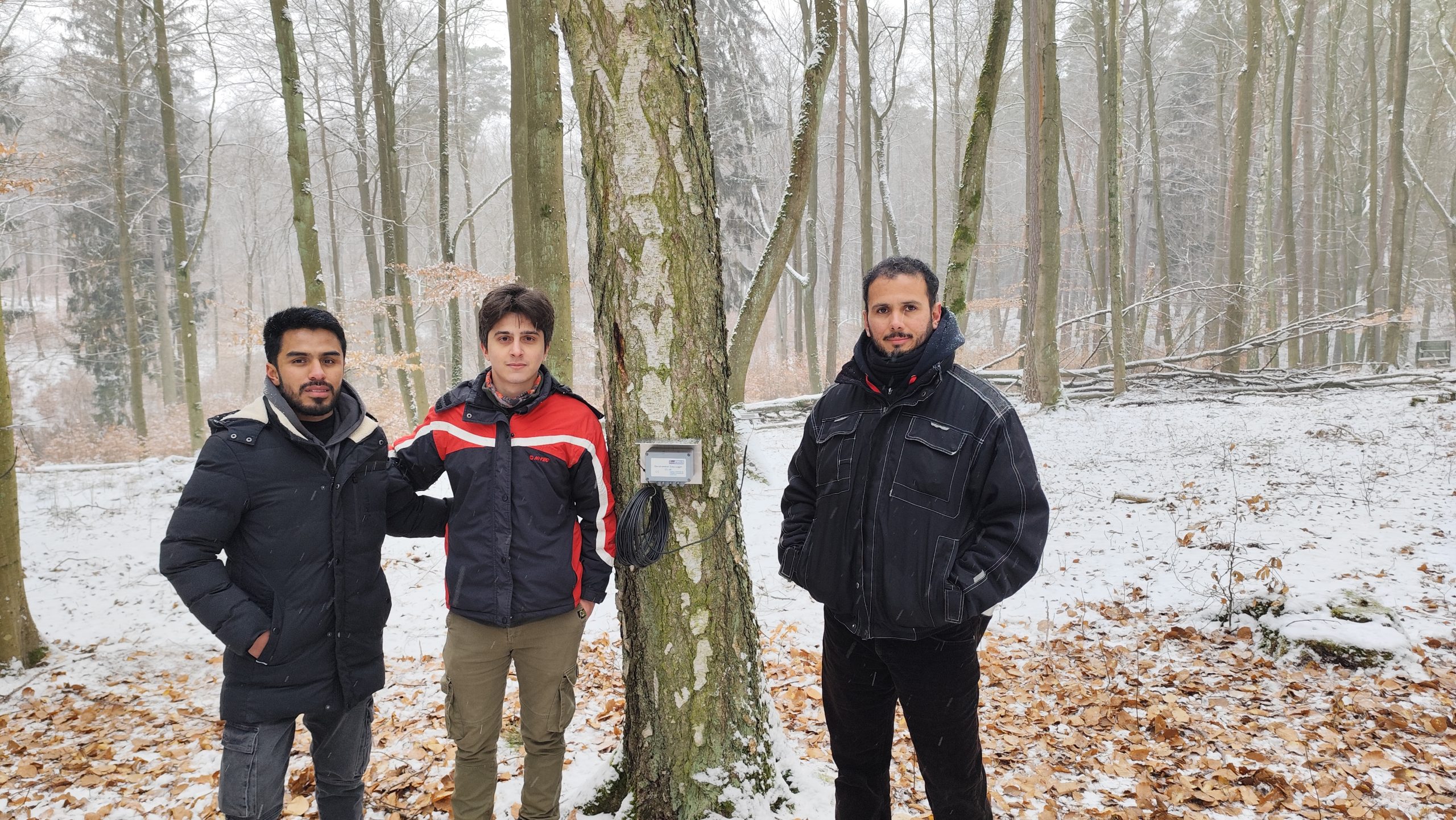
From left to right: Alexander Tolentino Santiago, Mehmet Furkan Kahye and Prof. Luis Miranda /Credits: Ritik Gill
Guest Article by Mehmet Furkan Kahye, Forest Engineer and currently enrolled in an M.Sc. in Forest IT
📍 Haselberg, Brandenburg, Germany
In the heart of a Marteloscope near Haselberg close to the Polish border, a set of researchers and forest enthusiasts got together to install high-precision sensors on selected trees. These sensors are called DR1 Dendrometers, which record microscopic changes in the trunk diameter every thirty seconds and thereby present a unique chance to monitor tree growth dynamics with much accuracy. Along this, we also took tree-ring samples, which will tell us the exact age of the trees.
This campaign is part of a larger project, blending cutting-edge technology into sustainable forest management and climate change research. Continuous growth measurements offered by dendrometers would inform studies on how trees respond to environmental changes, such as temperature variations, drought stress, and seasonal growth rhythms. These insights are very important for adapting forest management techniques against several climate change challenges.


Importance of Tree Growth Monitoring:
Forests are dynamic ecosystems with complex responses to changes in their environment. Their monitoring really yields important insights into tree physiological responses, carbon sequestration opportunities, and ecosystem health. Such information helps with:
Climate Change Research – Enhancing the knowledge of trees’ responses to differing climatic conditions can underpin adaptation strategies for forests under stress.
Forest Health Monitoring – Growth anomalies can be an early warning for pest infestation, disease, or drought-related stress.
Sustainable Forest Management – Data on growth assist in deciding thinning, harvesting, or conservation strategies that maintain healthy and resilient forests.
Field Operations: An Intercollegial Effort
The fieldwork was a cooperative effort between Prof. Luis Miranda, Ritik Gill, Alexander Tolentino Santiago, and myself, Mehmet Furkan Kahye, working jointly to install the sensors and take core samples for dendrochronological analysis. It involved high precision, as even a slight mistake in placing the dendrometers could change the results.

Future Implications
Having installed the sensors, we will continue by monitoring the data collected to understand how each tree responds to environmental conditions over time. This current study will feed into much bigger work revolving around forest dynamics and sustainable management across European forests.
For more information about the DR1 Dendrometer and the applications for its use, you can visit the manufacturer Ecomatik
Only by connecting novel monitoring tools with traditional forest practice can we transition towards a more scientific approach to forest conservation and management.
*The opinions expressed in our guest articles are solely the author’s and don’t necessarily reflect the opinions or beliefs of the website and its affiliates.