

Article written by Katharina Freund, Theresa Frei, Hannah Ertelt (European Forest Institute)
How can genuine dialogue about forests succeed?
This question stood at the beginning of the Martelkom project and became the starting point for its new guide “Forest Dialogues”, developed at the European Forest Institute (EFI) together with colleagues from the Forest Research Institute Baden-Württemberg (FVA).
The debate about the future of our forests is no longer purely technical. Climate change, nature conservation, timber production, and recreation – all play a part in forest management in Germany. Yet both citizens and forestry professionals often feel that their concerns are not fully understood. Foresters, as representatives of forest management, are also mediators between their profession and a society that increasingly demands participation and wants its views to be heard.
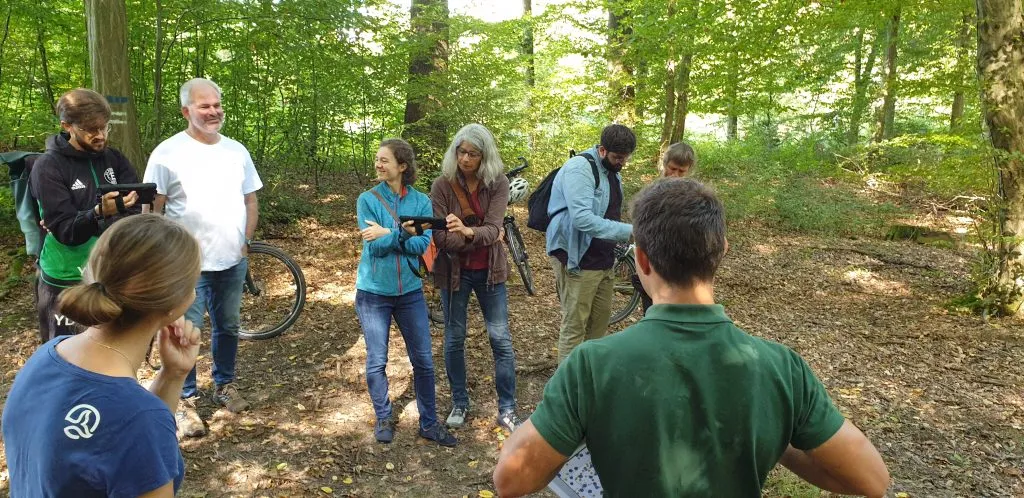
But how can such a dialogue about the future of Germany’s forests take place – at a time when traditional answers are losing persuasive power and new approaches are being discussed controversially? This very question led the Martelkom project team to seek dialogue where it can truly emerge: in the forest itself. They wanted to find out how encounters evolve when conversations take place directly among the trees and different perspectives meet face to face.
Marteloscopes: Encounter and exchange directly in the forest
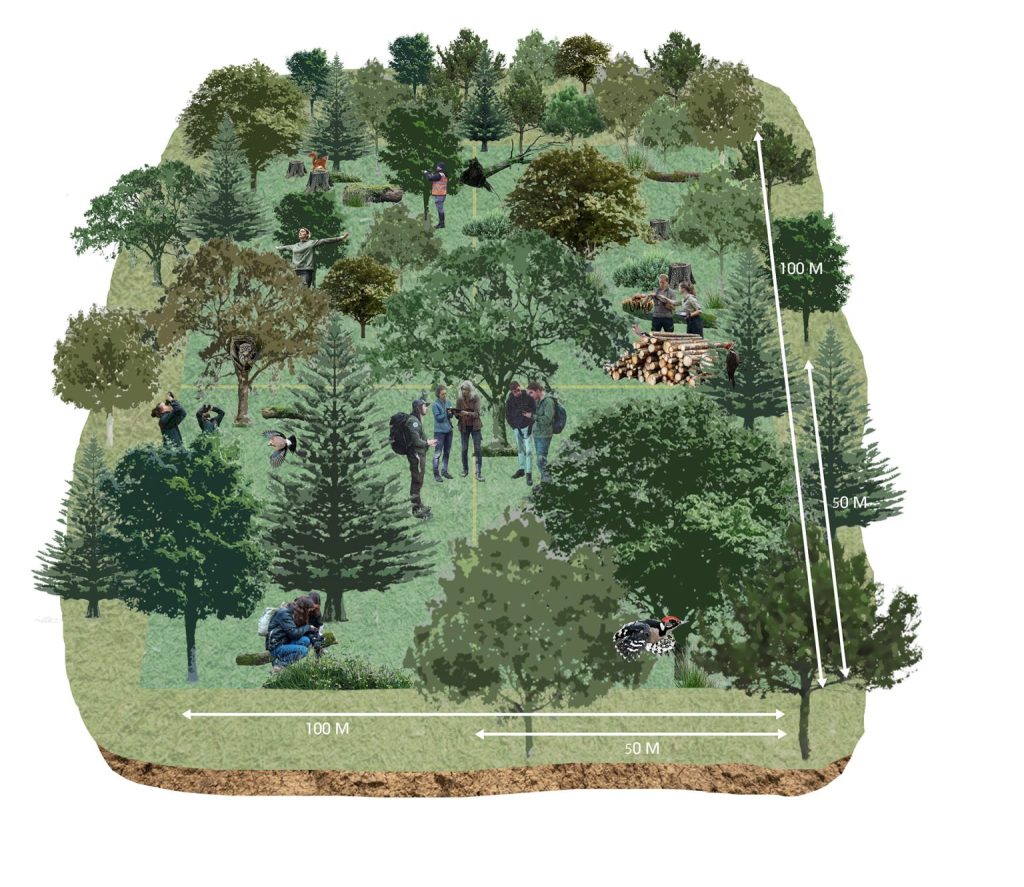
To do so, they used so-called marteloscopes (designated training plots in the forest where management decisions can be simulated in real-life conditions). These marteloscopes are part of a growing network of around 280 sites coordinated by the Integrate Network. Here, what often sounds abstract becomes tangible. A wide range of participants – pupils, citizens, environmental activists, and of course local foresters – were invited. Together, they met in the forest, discussed trees, decisions, and responsibility – sometimes thoughtfully, sometimes passionately. These encounters were accompanied by social-scientific observations and group discussions. A nationwide representative survey provided additional valuable insights: How do people in Germany perceive the forest? How do they experience their interactions with foresters?
And behind it all, a series of guiding questions continued to drive the work: How is the forest perceived? What matters most to people concerning forests? What happens when people with different values and viewpoints stand together in front of a tree and discuss its future? And how can professional knowledge and personal experience, expertise and emotion, come together in genuine dialogue?
Even the first forest exercises showed how lively this approach can be: “The marteloscope exercises allowed us to spend several days in the forest, listening, observing, and talking directly with people,” recalls Theresa Frei, who led the project together with colleagues from the FVA Baden-Württemberg. “It was fascinating to see how quickly discussions about individual trees turned into deeply personal conversations – about childhood memories, worries about climate change, or the use of wood products. And about the question of how we can take responsibility together,” adds Hannah Ertelt, research associate in the project team.
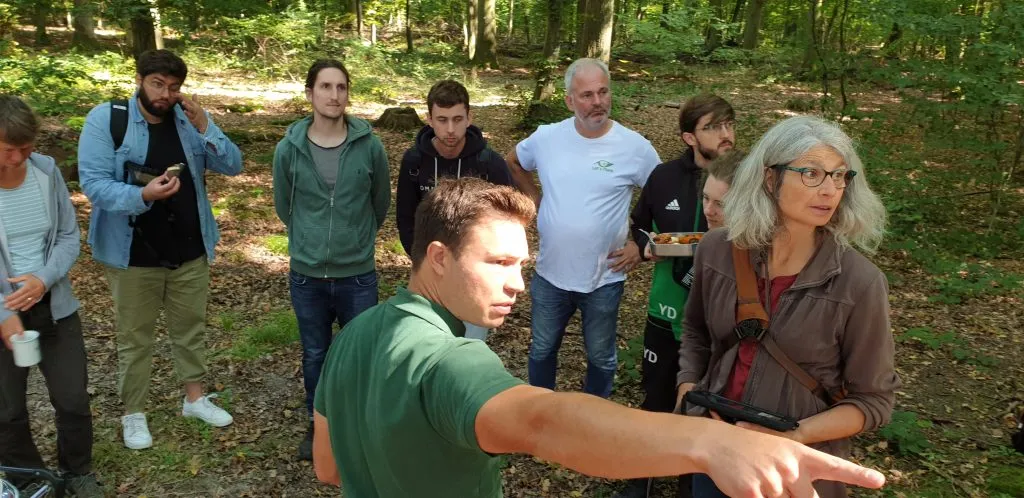
The path was not always easy. Because the goal was to reach very different groups, the team found it challenging to get enough participants from specific target audiences for the marteloscope sessions. The more specific the group, the smaller the turnout – while broad public invitations mainly attracted those already interested in forests and the environment. One key challenge remains: how to engage social groups that rarely come into contact with forest management at all.
And yet, the enthusiasm of those who did participate was unmistakable. After only a few minutes, there was a special energy in the air: openness, curiosity, and genuine interest in the forest. Again, fascinating conversations arose, filled with laughter, debate, and reflection. Some participants were so inspired that they asked whether they could organize their own marteloscope sessions. That was a strong signal: the approach works. The forest, and especially the marteloscopes, can become true spaces of encounter where open and honest exchange is possible.
Foresters and citizens in conversation
When the results from the surveys and discussions were evaluated, the initial feeling was confirmed: people want to understand what drives foresters. They want to comprehend the uncertainties that climate change brings, and how disturbances such as bark beetles, storms, or wildfires influence management decisions. They are curious to know how decisions are made – which trees stay and which must go.
The participating foresters, in turn, appreciated the chance to talk about their work beyond professional circles and to hear citizens’ views and reflections. When professionals can openly share that they, too, are learning, experimenting, and searching for ways to make our future forests more resilient, it creates space for genuine listening and mutual understanding.
All this led the project to its goal: to develop a practical guide that facilitates exactly that: real encounters in the forest.
Guideline “Forest Dialogues” – practical tips for successful dialogues
The practical guide “Forest Dialogues” is not a thick final report to be opened once and set aside. It is a hands-on tool for practice: easy to use, clearly structured, with concrete steps, a checklist, and reflection questions designed to inspire conversation.
It is aimed primarily at foresters who wish to see the forest as a space for dialogue – whether they are private forest owners, municipal or state foresters. However, it can also be used by educational professionals, ideally in cooperation with forestry experts.
In the guide, readers will find advice on how to prepare and moderate marteloscope sessions, how to reach suitable participant groups, and how to shape discussions that spark curiosity rather than conflict. It also invites reflection on one’s own relationship with the forest: What does the forest mean to me personally? How do I feel about its changes? And how can I share these thoughts and emotions in conversation with others?
Perhaps this is the most important insight of the project: sharing uncertainties and open questions is deeply human. And this creates trust – the foundation for honest communication.
The forest offers the ideal setting for that. It makes forest management visible, tangible, and discussable. At the same time, it provides calm, reflection, and connection – a living space that encourages openness and clarity, where people can truly meet, even on controversial topics. In this way, the forest becomes a place for genuine exchange and shared learning.
The guide is therefore more than just a result – it is a beginning. An invitation to listen, to learn together, and to take new paths. For the future of our forests, and for better understanding among all who use, protect, preserve, or simply love them in their own way.
“Forest Dialogues” can now be downloaded free of charge as a PDF and printed if needed – available in both Englisch and German.
Take it with you into the forest, try it out, and start your own conversation under the trees.
Martelkom is a joint research project of the European Forest Institute (EFI) and the Forest Research Institute of Baden-Württemberg (FVA). Its goal is to bring together different societal needs regarding forests and sustainable forest management and to support communication on these topics. The project is funded by the Federal Ministry of Food and Agriculture and Regional Identity (BMELH) through the Agency for Renewable Resources (FNR) based on a resolution of the German Bundestag.