

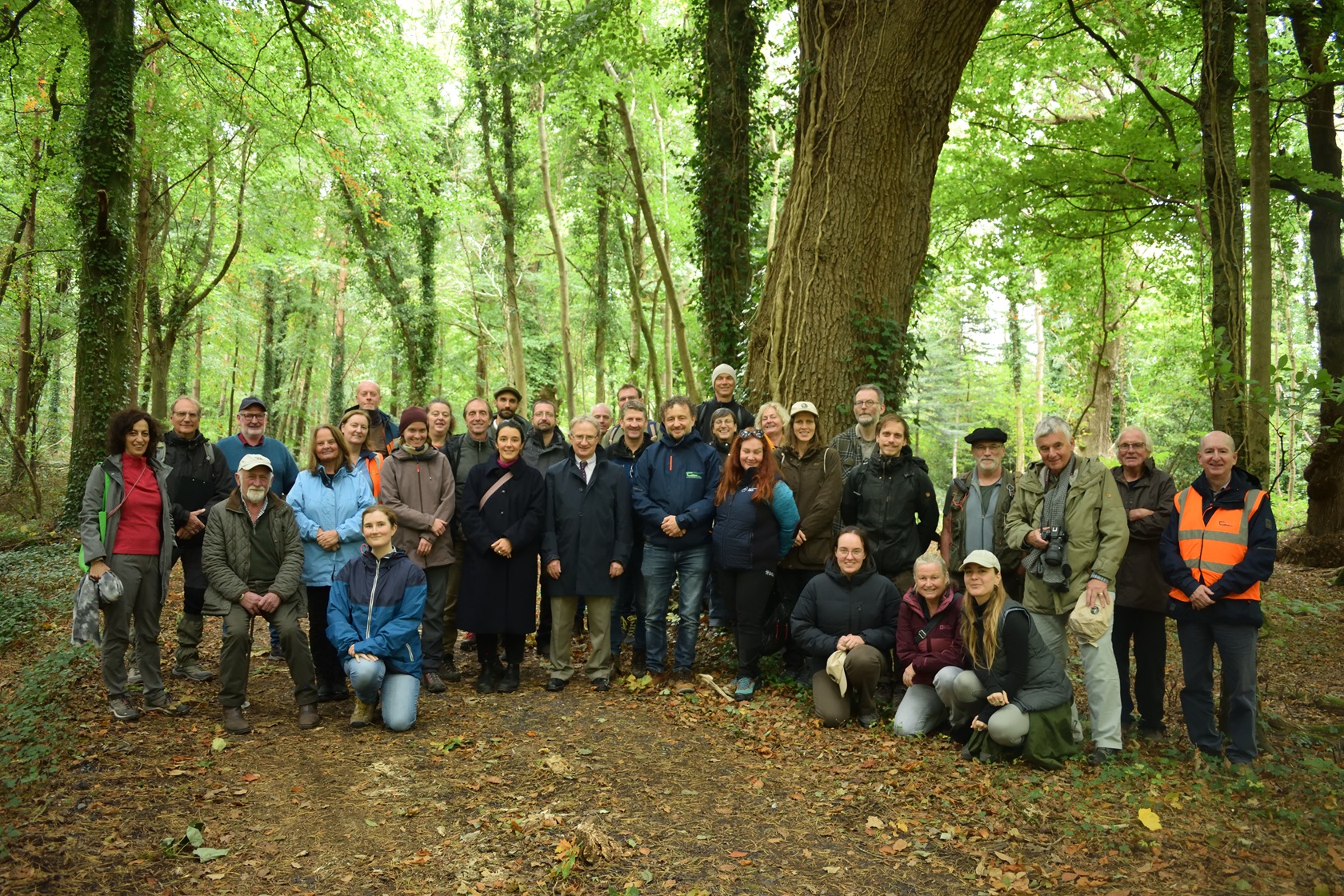
It was a dark and murky evening as I paved my way through Harcourt Street in Dublin. That’s when I suddenly found myself in a pub – not the kind where a lad or lass would sing a folk song – but rather a cosy, wooden, meeting room turned pub, where I’d stumble across familiar forest faces. Of course, I was in the right place – the social reception of our Integrate Network Annual Meeting! Starting off with a traditional Irish dance workshop, organised by our chairs, we started our gathering with some artistic engagement and reminisced about our past meeting in Austria. Such a social reception provided fertile ground to dive into an intensive 3-day programme on “Promoting Integrative Forest Management Practices in Managed Forests through Policy, Science & Practice” – reflecting on pioneers in young forest lands and the journey of “a forest culture emerging” in Ireland!
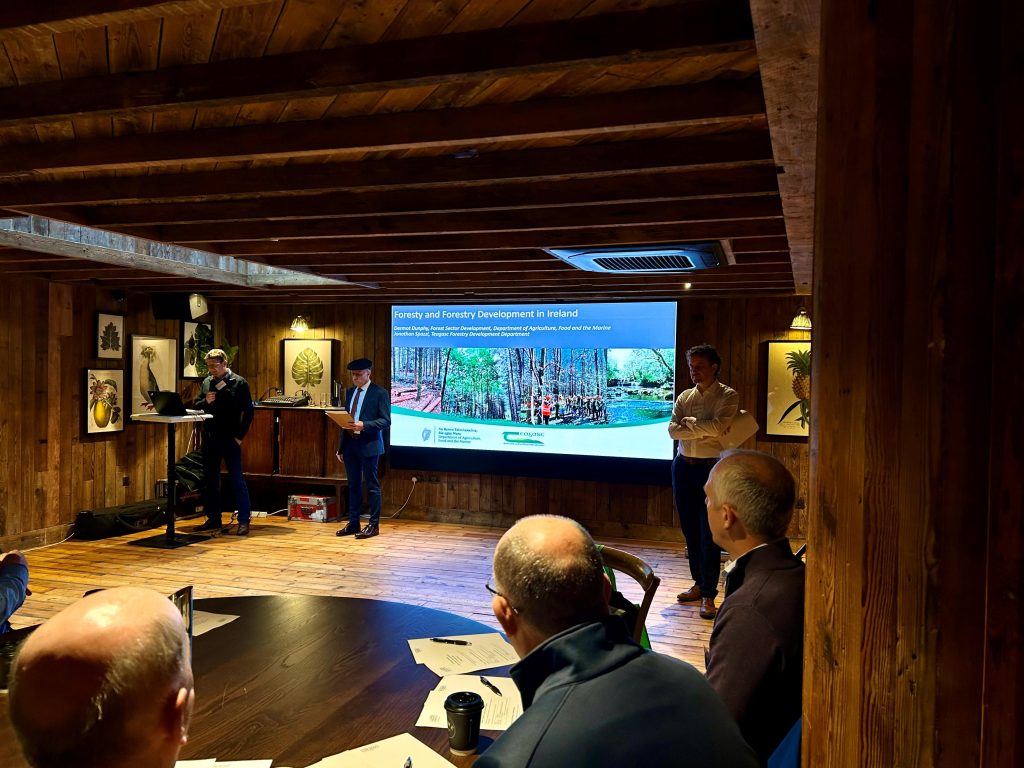
On the conference day, we were warmly welcomed by the current chairs, Dermut Dunphy (Department of Agriculture) and Jonathan Spazzi (Teagasc). They introduced how, during the Annual Meeting, we will look closer at transformative approaches, in a country having a forest cover of currently 11% – highlighting that Ireland is still a “blank canvas” of some sort. Michael Healy-Rae (Minister of State at the Department of Agriculture) added that the forest is like an animal, you don’t let it get devastated by bad weather, you ensure taking care of it. Forests are as diverse as their owners, and so are forest management approaches. Thus, co-learning and exchange are crucial, as emphasised by Jonathan, and that is what the Integrate Network stands for. Andreas Schuck (EFI) echoed this as he greeted everyone on behalf of the Integrate Secretariat. Bringing attention to the research-policy-practice nexus that drives the work of the Integrate Network, he mentioned, “policies only work if they are applied in practice and supported by scientific evidence”.
How can concepts, new networks and EU legislation support biodiverse and resilient forests?
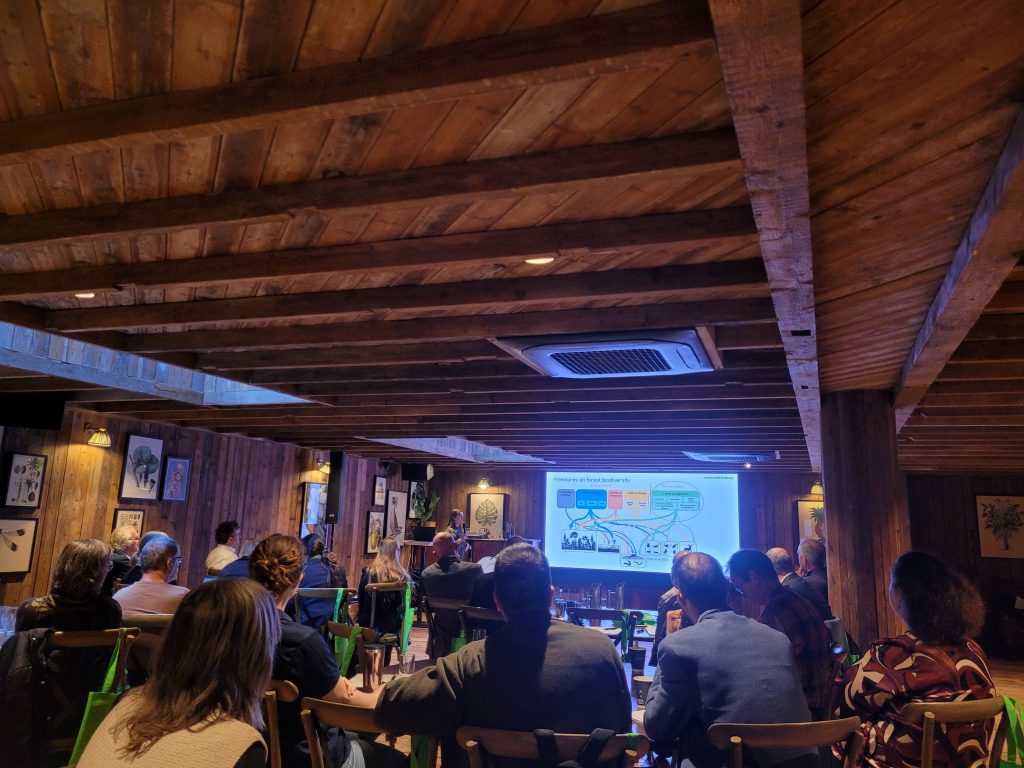
The scene was set for Rahel Könen (EFI) to moderate through the first set of presentations. Andreea Spinu (University of Freiburg) shed light on the origins and understanding of diverse forest management terms, such as continuous cover forestry, integrative forest management, close-to-nature forest management, and biodiversity-friendly management. In the HE Transformit project, they investigate the scale of these concepts in relation to biodiversity challenges, not only at the stand level but also landscape level. How to deal with the many biotic and abiotic risks to forests was presented by Silvia Abruscato (EFI), coordinator of the Pan-European Forest Risk Facility Secretariat (FoRISK). The increase in disturbances asks for timely, expert-based input – especially as disturbances start occurring in regions with limited experience in dealing with them. To facilitate this process, this knowledge hub and network bring together different actors and strive to become a platform that shares innovative approaches, good practice examples, evidence-based lessons learned and provides expertise and knowledge in emergency cases. We continue at the European scale with Stefanie Schmidt (DG Environment), providing us the latest updates from the European Commission, in particular on the policy frame (e.g., the voluntary guidelines, nature restoration regulation), incentives, and the next steps on the EU agenda (i.e., developing rules and standards for biodiversity-focused voluntary forest certification schemes and nature credits). Then we moved to a more local research practice. Ian Short (Teagasc) gave us insights into Continuous Cover Forestry (CCF) in science and on the ground, from an Irish perspective. What started as a search for alternatives to clear-cutting evolved into a long-term recording of experiences transforming Sitka spruce (Picea sitchensis) stands to CCF, which we had the opportunity to observe on the last excursion day.
“You can’t manage what you didn’t measure”
As forest managers, everyone knows it can be beneficial to have an easy-to-use diagnostic tool for biodiversity-oriented management. This is where the Index for Biodiversity Potential comes in, presented and developed by Pierre Gonin (CNPF) and Laurent Larrieu (CNPF). This index is based on a rapid assessment of ten factors that influence the capacity of forest stands to support animal, plant, and fungal species. Since 2008, it has found its way from research into practice, sparking interest and use by Jonathan Spazzi (Teagasc) and Teresa Baiges (CPF), who shared their practical experiences. Later, on the second day of the programme, we had the chance to experience an IBP assessment first-hand during a field training.
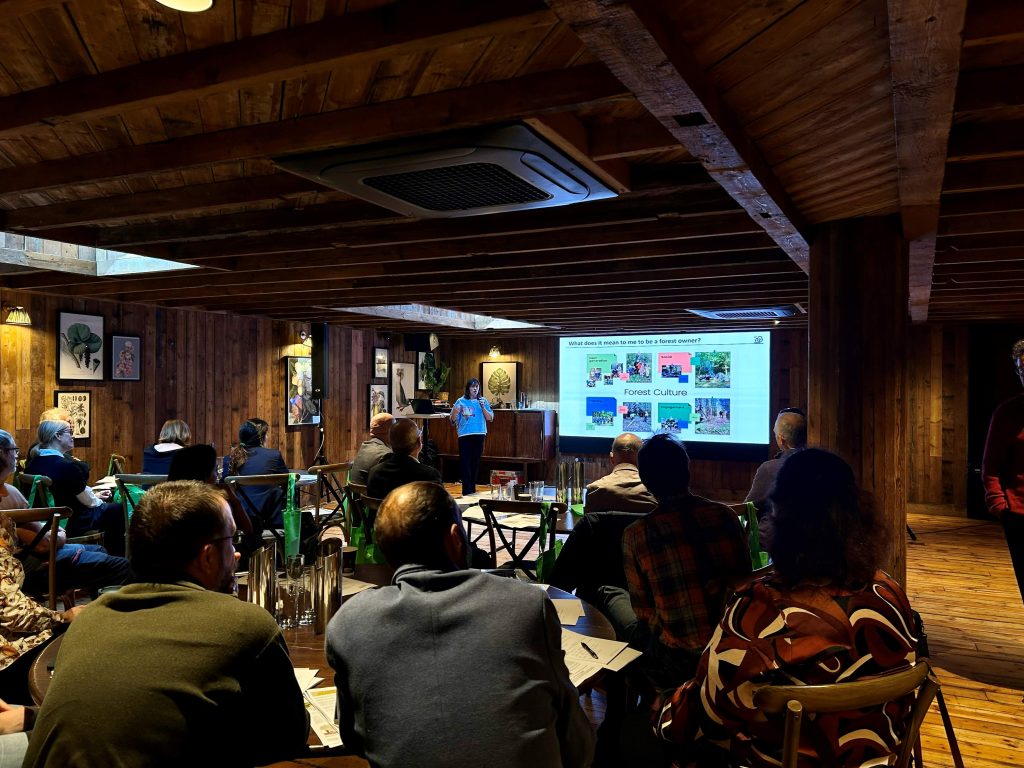
“Communication and training are vital tools that we learn from” said Pádraig Ó Tuama and Manus Crowley (Pro Silva Ireland). Coming from a monoculture forest culture of clear-cutting and replanting, biodiversity was mainly confined to native woodlands. However, with the transformation in management and culture, biodiversity in forest stands was improved. An important driver is exchanging knowledge and perspectives, especially through in-forest field events. As early pioneers, they conveyed their experience through demonstration and research plots, and soon ProSilva turned their training into a so-called ‘community of practice’. This story was echoed by Olive Leavy, giving a forest owner’s perspective –describing the community as a motley crew, working towards the same goal. For her forest, it was important to have peer support to transform her ash dieback stands. Transforming Ireland is a shared endeavour in which the people are important –including trust in support, education and financial incentives that can encourage forest owners to implement changes. Forest culture is therefore an important factor for change, she noted. During the afternoon, an interactive World Café, facilitated by Jonathan Spazzi and Rahel Könen, encouraged meeting participants to share their experiences and listen to voices “from the ground” by having an Irish forest owner present at each of the five tables. The opportunity to exchange perspectives related to challenges and opportunities of implementing forest management and biodiversity conservation was well received. Elaborating a common vision on how to collaborate better was a central discussion point and can be read about here. Thereafter, Elisabeth Schatzdorfer and Bernhard Wolfslehner (EFI) presented the Forest Knowledge Gateway, a new knowledge-based platform that serves as a valuable entry point for finding relevant scientific and practical information, inspiration and contacts for supporting integrative management and forest restoration efforts. The evening concluded with a lively dinner, and the next morning the group shifted from theory to practice – ready to firsthand explore Ireland’s forest landscapes.
Devils at Work
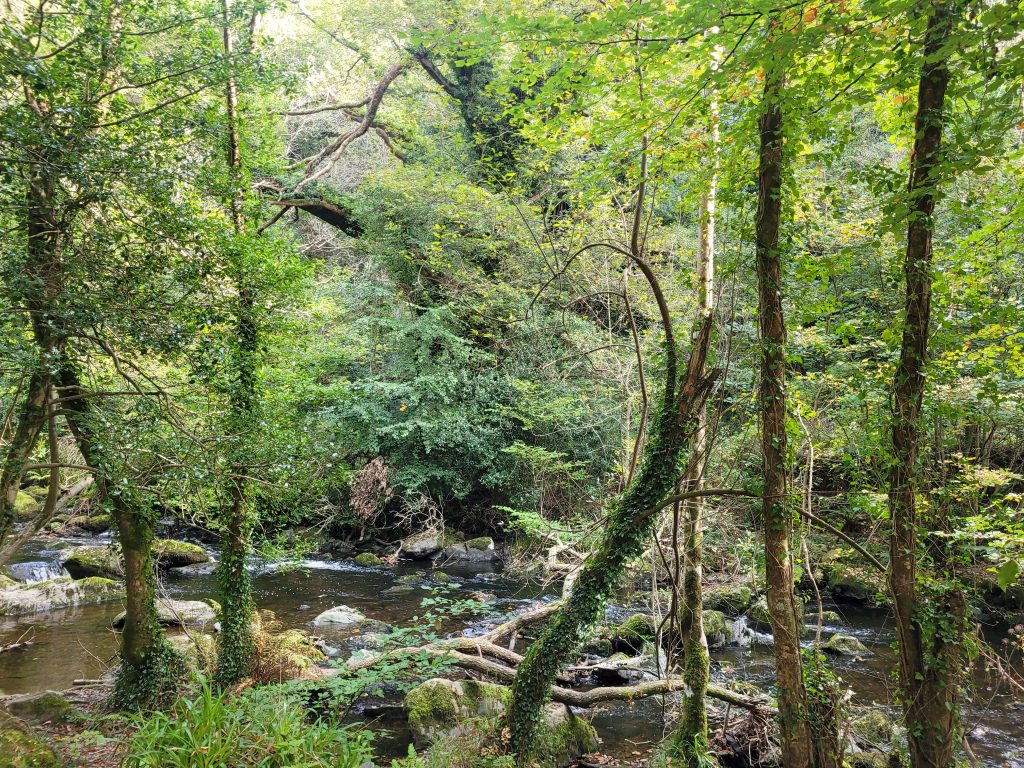
On the second day, we were on our way to the first excursion stop called “Devil’s Glen”. As the legend says, the landscape was formed by an enraged Devil, announcing great doom. On the contrary, we found a story of collaboration between different stakeholders, bound together by a river, the Vartry, that runs through the valley. We met Declan Little (Coillte) and colleagues, and a representative from Inland Fisheries Ireland. The stream itself is affected by the different neighbours, 2 strategies, and a common goal. These woodlands, being 120 ha of mixed forests, are used on one side of the river commercially and on the other for biodiversity conservation. As we were walking towards the river, it was not the devil’s roar or waterfall we witnessed, but instead flutes that sang as the river flows – a musical endeavour organised as a surprise by our Irish chairs. As we enjoyed a couple of traditional songs, we learned that at this river, they saw a decline of salmon and trout, as the river was under pressure from dams and adjacent towns. On Coillte’s side, non-native species have been pressuring the endemic vegetation, including e.g. Laurel (Prunus laurocerasus). Coillte and the Fisheries found each other, and there were no Devils at work there.
They aligned goals and found a common interest in the preservation of a healthy forest and river. Coillte started with promoting a direction towards native woodlands, favouring locally adapted species, and transforming stands to a CCF management system. In turn, this favoured the river and its natural dynamics. There was a need to slow down the river and, in this way, restore river dynamics. Trees were felled in the right direction, bulking them up, thus creating ecological niches for fish and creating pools for cover. By creating gaps in the canopy, more light reached the grounds and affected the temperatures in the water. The effect seemed to have paid off, as the salmon have come back since 2015, and trout are also higher in numbers. Coillte promotes native species, more structure in forest stands and biodiversity, which aligns with the goals set by Fisheries.
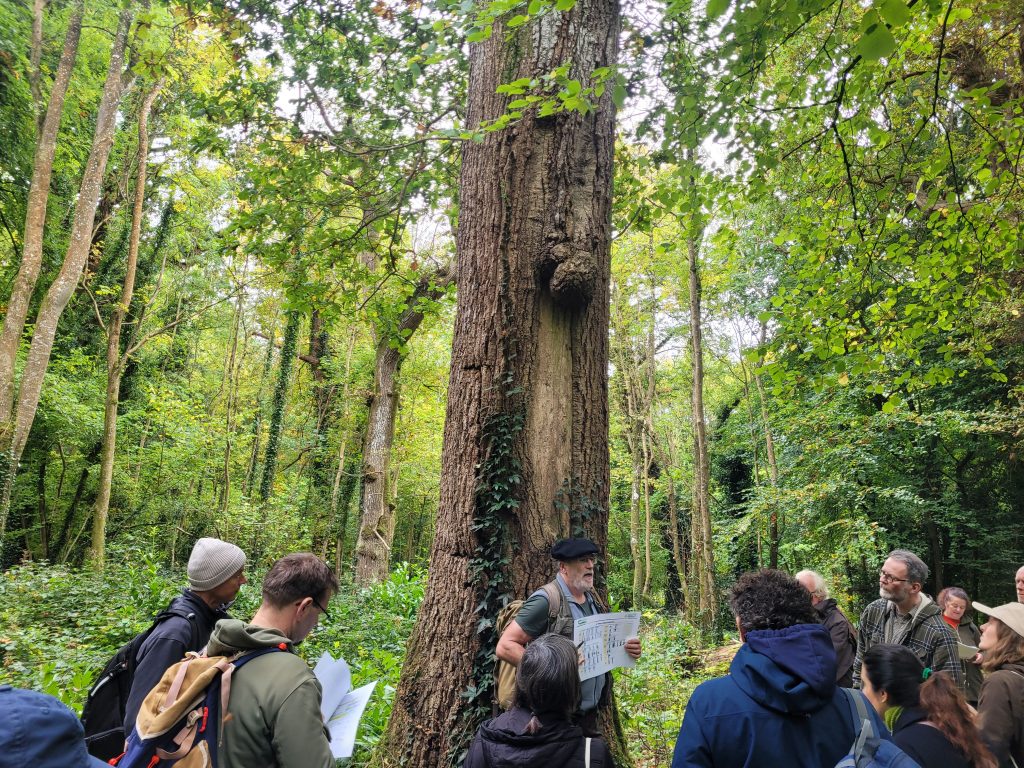
Discussions continued over lunch in a pub and set the scene for the afternoon at Oak Park near Teagasc HQ in Carlow. At the field site, we are welcomed by the Teagasc director, Frank O’Mara. He touched upon the importance of the Integrate Network, as it corresponds well with what Teagasc stands for, bringing together education, research, training, and professional support. As Irish forests are very young, they offer many opportunities for enhancing biodiversity and adapting to a future climate. In Oak Park, our main activity was to get familiar with the IBP assessment. We received the training from Laurent and Pierre, who introduced the field guidelines before splitting us into groups. By walking and observing along transects, we worked through the 10 factors, including, e.g. native tree species, vertical stand structure, deadwood, and tree-related microhabitats. In the debrief, we discussed the group’s results, and all agreed that the IBP is a useful diagnostic tool to inform management on what works well and where there’s room for improvement, on which factors it is doing well and where to improve if possible. With that, a long but fruitful excursion and discussion day ended.
A Leap in Time
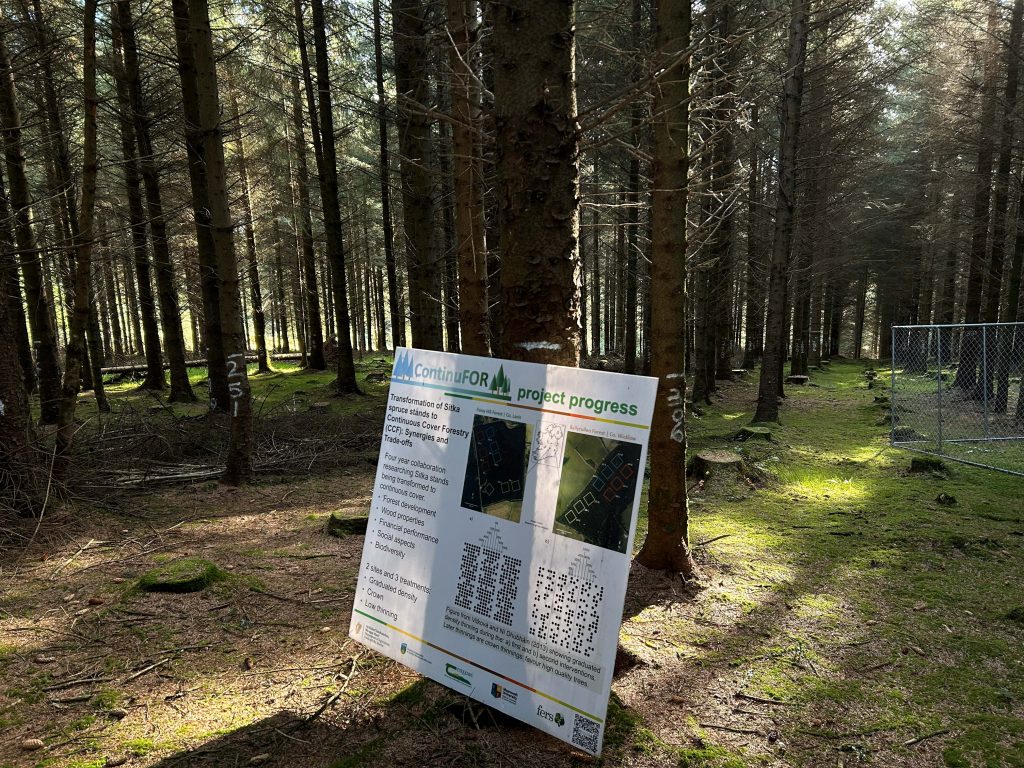
Day three shifted focus from river-side collaborations and diagnostic tools to experiences of CCF pioneers, where experimentation, resilience, and long-term commitment shape both wood and woodland culture. We visited a forest owner who had engaged in the process of converting a Sitka Spruce plantation to CCF. The forest site in Ballycullen was established in 1996, with the help of afforestation grants. At the first thinning stage, the forest owner (Sandra and Lasse Jorgenson) reached out to Ian Short (Teagasc). Ian set up a research plot for recording the transition process. We started off in a low thinning plot, where it was quite dark, with little vertical structure. As we moved to the Gradual Density Thinning plot, we were able to observe a lighter structure, as well as variety in diameter classes. With enhanced microclimates and improved light conditions, the scene was set for natural regeneration. However, we could observe –in a fenced control area for monitoring browsing–that, similar to other countries, the challenge lies in regulating deer populations to ensure proper regeneration. Despite the browsing discussion, all participants congratulated the owner for taking on the challenge towards CCF.
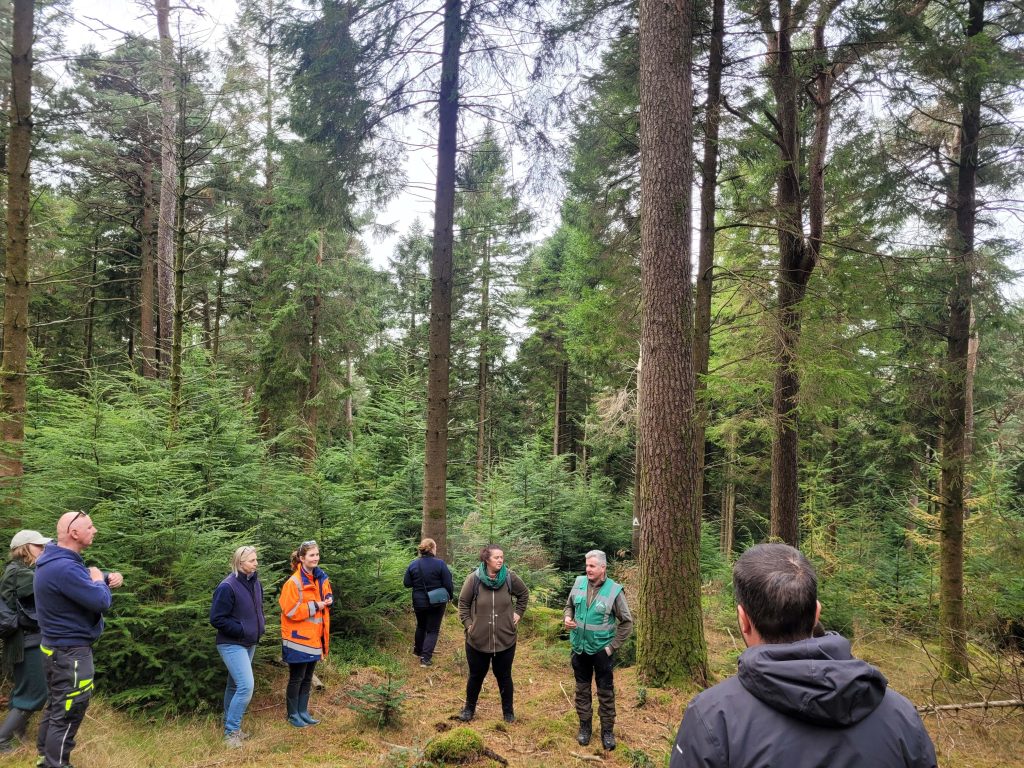
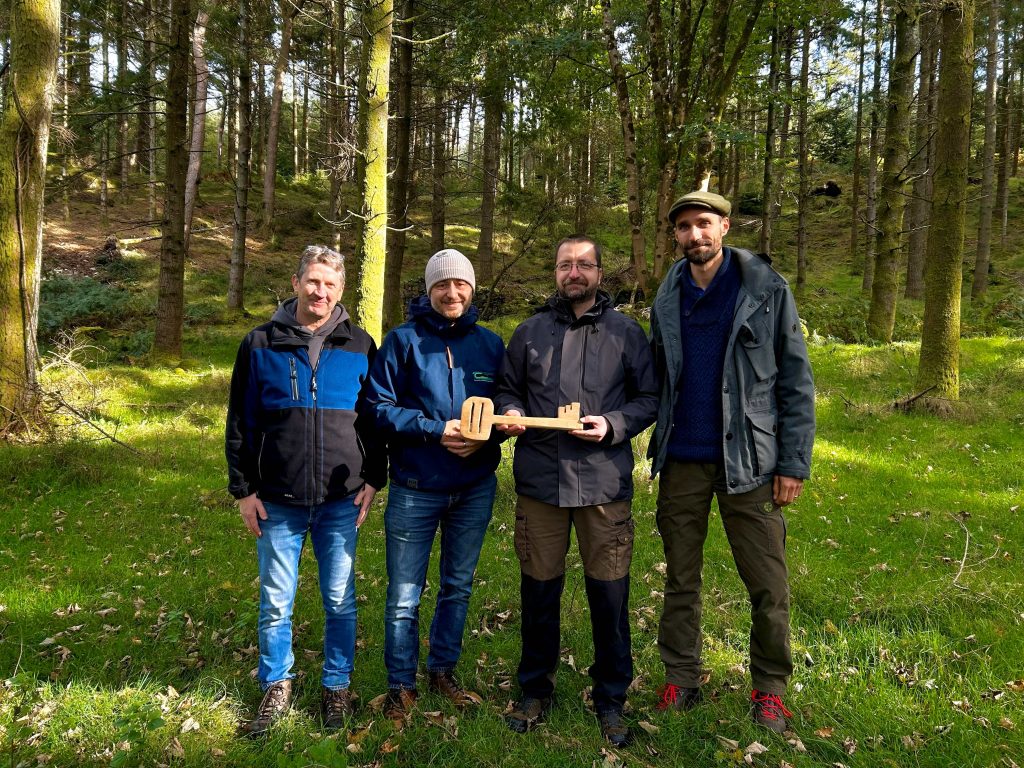
We then took a leap in time and arrived in Ashford, Cloragh forest, where we visited a well-developed CCF forest with diverse structure, regeneration, and large Sitka spruce trees. We were guided by Liam Byrne (Pro Silva Ireland), whom I experienced in the ForestMOOCforchange with a feature on Cloragh forest. I was thrilled to see the forest now in person. The forest is owned by Lucy and her family, and Liam supports the management. ed much appreciation and respect for. Within these stands, the quality for both ecology and economics is being checked, as it is a forest delivering valuable timber products and diverse ecosystem services. This forest is, for good reason, seen as a pioneer example for CCF adoption in Ireland – something participants show. As the meeting ended, we got to enjoy a surprise lunch at a Viking film set, nestled in the forest. Through the key hand-over, the chairmanship officially transferred to Hungary, promising a new thematic context addressing the impacts of drought, heat and invasive species on forest resilience.
We thank our Irish chairs very much for a memorable Integrate Network Annual Meeting! Time to look forward to a fruitful and engaging new year – with the network’s 10-year anniversary and Hungarian chairmanship upcoming in 2026!
Text: Silvester Boonen, Andreas Schuck, and Rahel Könen
Pictures: Silvester Boonen, and Rahel Könen
Video footage: Rahel Könen
Video production: Raghav Sharma