


Article written by Katharina Freund (European Forest Institute)
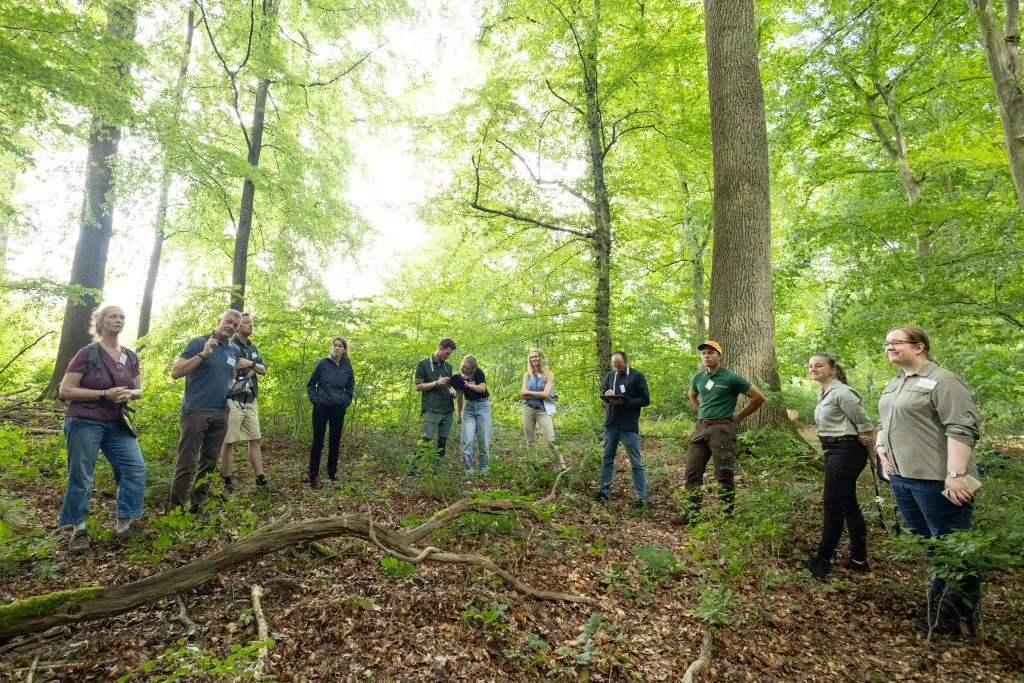
It’s a fresh morning after days of scorching heat when we gather in the Kottenforst near Bonn early on June 26. The air feels heavier than before – humid, almost tropical – and one can sense a thunderstorm approaching. The forest seems subdued, almost as if it was deeply breathing, anticipating the tension of the day. That’s exactly how it felt like standing there – at the edge of a very special piece of woodland that we would not just observe, but truly experience: the marteloscope – a one-hectare forest area where all trees are mapped and recorded with their ecological value (such as tree cavities and deadwood) and its economic value (timber price per tree).
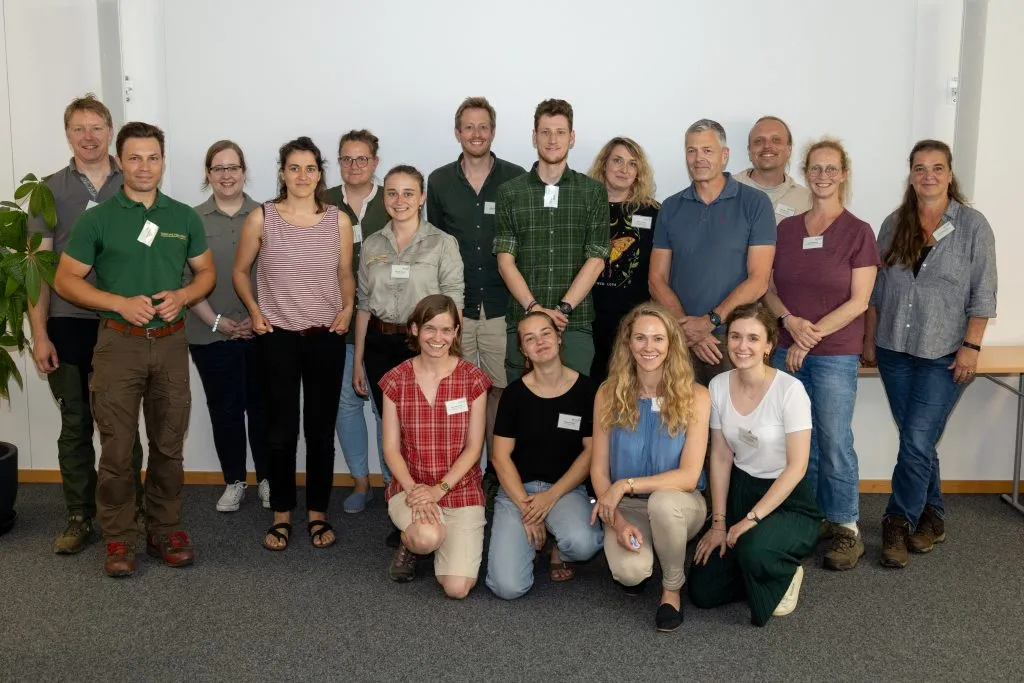
Foresters, scientists, educators, and other interested parties have come together to learn – not just about forest management and biodiversity, but also about communication. Because the final workshop of the Martelkom project is more than a conventional expert gathering: it creates space for dialogue between people and the forest. Between ecology and economy. Between emotions and silvicultural decisions.
We begin with a brief introduction by Carolin Stiel from Wald und Holz, covering how marteloscopes have been used thus far in forestry education, professional exchange, and with school groups. But before we head deeper into the forest, we talk about wood.
Not about cubic meters or felling quotas, but about the things that surround us in our everyday lifes: the warm dining table where a family comes together. The soft parquet flooring that gives rooms this cozy feeling. The solid oak wardrobe that can last for generations. Wood is a renewable resource – but also a memory, an atmosphere, a feeling of comfort and security. Every one of these items once lived as a tree.
And this is where the question comes in: which trees do we remove – and which do we leave standing? What counts, what factors matter for this decision-making? Ecological value or economic benefit? And is there something in between – something that has to do with our relationship to the forest?
Perceiving instead of evaluating – a change of perspective
Before we start with the theoretical silvicultural exercises in the marteloscope, we are offered a quiet invitation: ten minutes alone in the forest. Without a tablet, without a goal or a task. Just with the question: How does this forest feel to us?
A seemingly simple shift in perspective – and yet, a powerful one.
I take a few steps and stop. The ground beneath my feet is soft, almost springy. Damp in places. In other ones, dry leaves rustle, then the moss gives way softly. I breathe in deeply – the air feels fresh, thick and pure. Clear and soothing. I hear a soft dripping, bird calls and silence. No traffic noise, no talking. I’m with myself and nature – in the here and now – fully aware and at peace. Some participants later talk about certain sounds and light moods that they suddenly felt more intensely, as well as feelings of calm or unease.
The forest becomes a place of quiet – and of ourselves. This perceptual exercise opens something – within us and how we perceive what comes next.
The marteloscope – a forest full of decisions
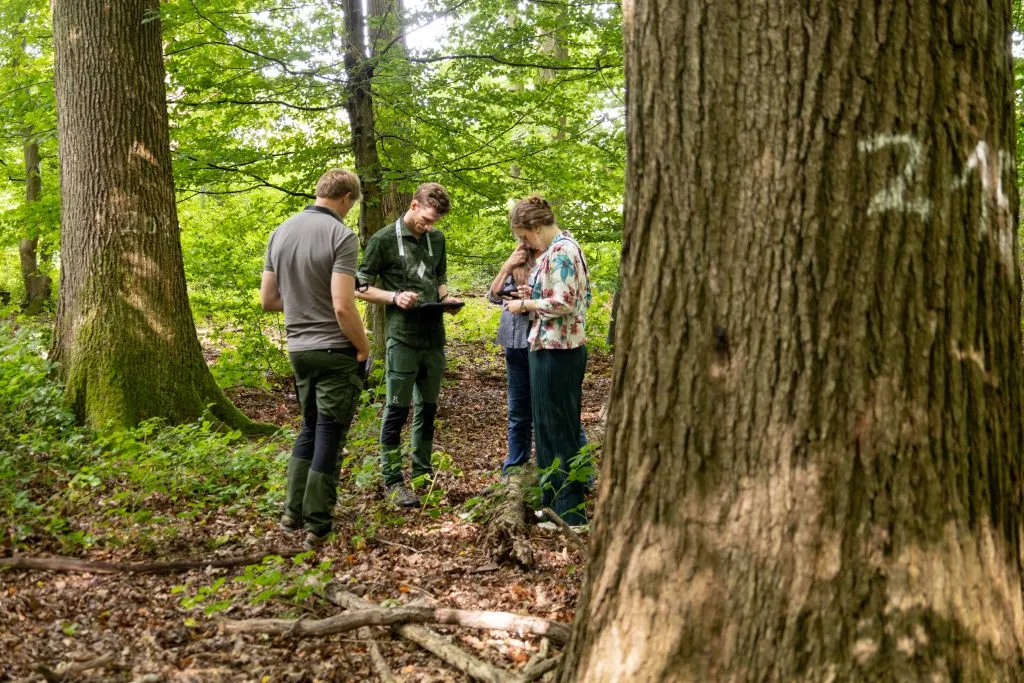
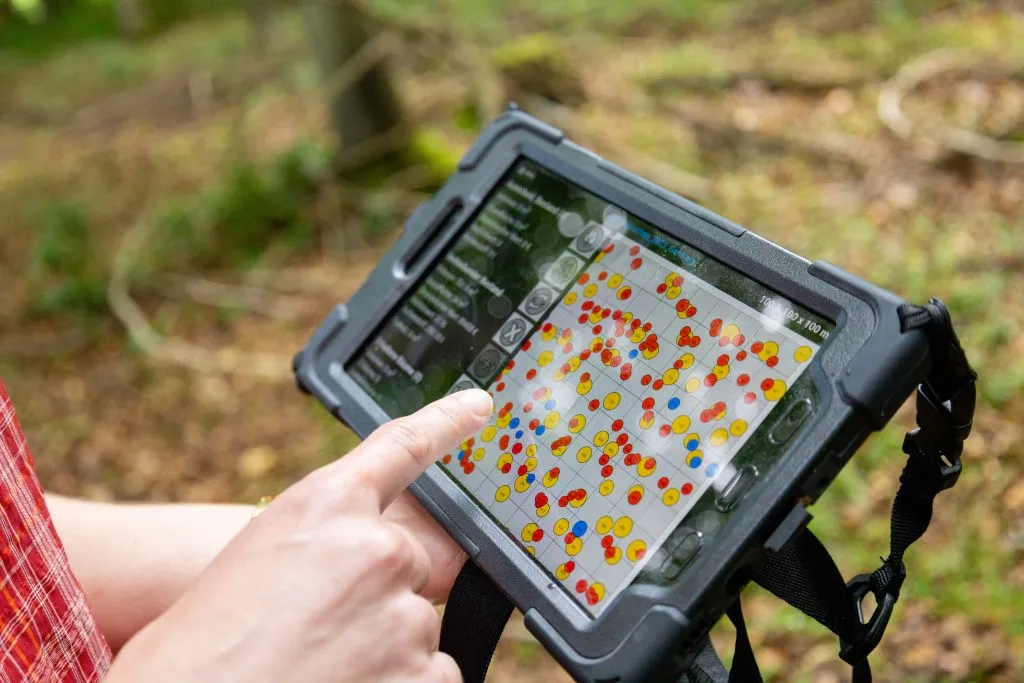
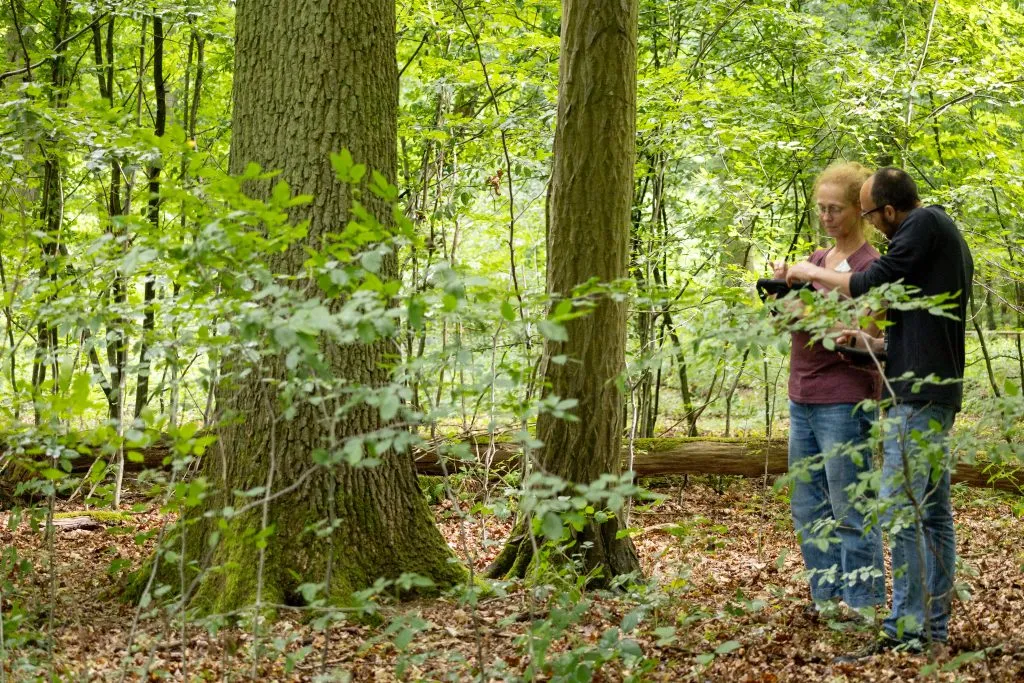
Marteloscope sounds technical, like measurements and numbers. And that is exactly what it is. A 100 x 100-meter area in which every beech, oak, pine, and piece of standing deadwood is digitally recorded. Each tree has a number and a measured value. The software on our tablets shows us data on diameter, height, timber value, but also ecological features such as tree hollows, deadwood or lichen cover. This is basically a classic training tool for forestry.
But within the Martelkom project, it has become more than a digital forestry lab. It’s a place for communication. After all, a forest is no longer a purely technical topic – it’s socially contested, emotionally charged and political. More and more citizens are asking: why are trees being felled? Who decides? And whose interests count?
Martelkom aims to build bridges between foresters and the public. Between industry and the climate movement. Between forest knowledge and forest feeling.
Mariella Zwickel of Wald und Holz NRW begins the technical session by explaining the meaning behind the word “marteloscope”: “Marteloscope comes from the French martelage – to mark – and the Greek skopein – to look. It’s about looking closely.” And that look is needed when other participants and I go into the forest in small groups with tablets to virtually remove trees or leave them standing. It quickly becomes clear that technical reasons don’t always feel right.
Like us, foresters often face a dilemma. On the one hand, there is demand for wood as a sustainable raw material and forestry operations must be economically viable. On the other, trees should grow old and reach high ecological value. This marteloscope exercise makes these conflicting goals tangible for everyone involved. It’s especially impactful after the sensory exercise: alone in the forest, in silence – an invitation to reflect not only on the forest, but also on our own attitude toward it. Which trees would we harvest for which purposes? Which would we leave – and why? Should we produce locally or import wood? Gut instinct vs. calculation. We discuss in small groups – and quickly realize that decisions in the forest are never clear-cut.
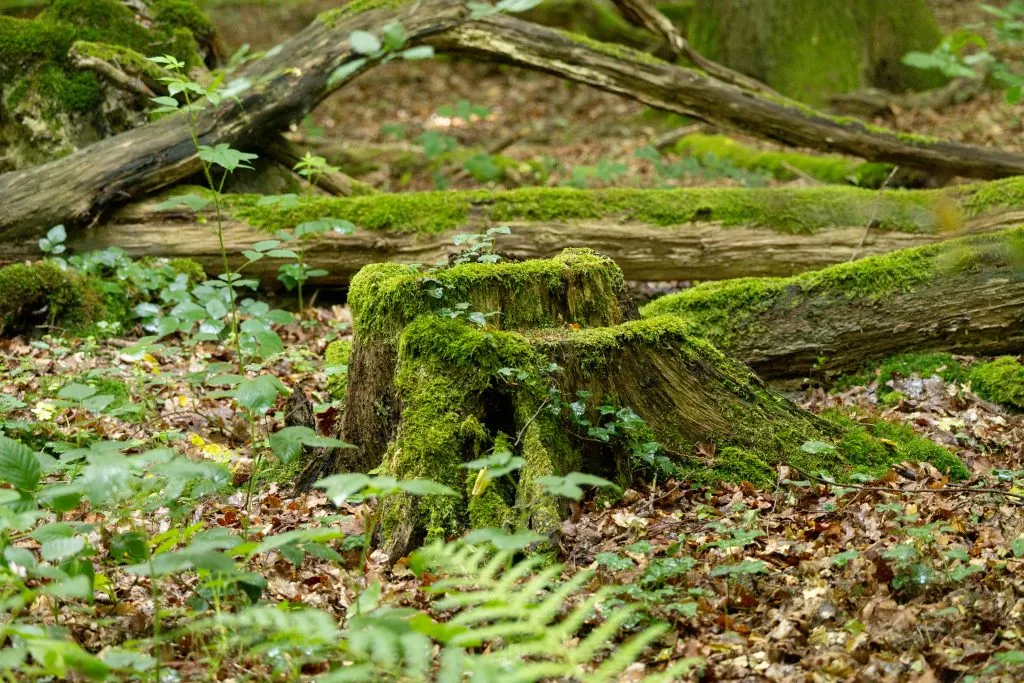
What was once seen as “ugly” – twisted, broken, mossy – might have been removed. But forestry perspectives have shifted: these so-called habitat trees have special ecological value. A woodpecker carves its cavity in the soft, decaying wood. A rare beetle crawls out from under the bark. Mosses, fungi, and lichens cover the trunk. What looks dead is often teeming with life – a microcosm for biodiversity. Even standing or fallen deadwood plays a vital role as shelter, breeding ground, and nutrient source. Biodiversity – the variety of life – starts with letting trees stay in the forest (like lying deadwood). These trees are deliberately left in the stand not despite, but because of their damage. They are purposefully excluded from use because they offer vital structures to preserve biodiversity.
In contrast, there are the so-called future trees: healthy, site-appropriate trees with straight growth and good crown structure, meant to anchor the next forest generation. They are nurtured and selectively promoted – for instance, by removing competitors, nearby trees that deprive them of light, water, or nutrients.
In one exercise, a mighty old oak is suggested for removal – not because of its monetary value, but because it blocks light and space for younger generations of trees. A forestry-sound decision. But for many, emotionally, it’s unthinkable. “This oak? But it’s impressive!”
That is where tension arises – and insight.
Back from the forest – into the dialogue
As the first raindrops fall, we make our way back to the European Forest Institute office. It was getting darker and windier outside, and shortly after we arrived at the office, a heavy thunderstorm breaks out. The rumbling of thunder and pouring rain seems almost like a powerful accompaniment to what we had just experienced in the forest – intense, layered, full of energy. And despite the storm’s force, many of us feel relief – finally rain, finally water for the thirsty forest. Indoors, protected from the storm, our conversations draw closer, grow livelier: what does this experience mean for the future of forest communication? How can we use the bond between people and forest?
Dr. Theresa Frei, Hannah Ertelt (both researchers at the European Forest Institute) and Manuel John (scientific project partner from the Forest Research Institute of Baden-Württemberg) jointly present the results of three years of Martelkom research. This included forest exercises and discussions with various social groups and foresters, as well as a Germany-wide survey on forest perception and communication – all with the aim of testing new ways of interacting with each other.
A key finding: friction is fruitful. Many participants who were initially critical, left with broader understanding. Not because they were convinced, but because they were heard.
Language also played a role: terms like “habitat tree,” “future tree,” or “competitor” are not always intuitive and can deter or stall dialogue. But when foresters share insights into their perspective and speak openly and as equals, it creates room for empathy and exchange.
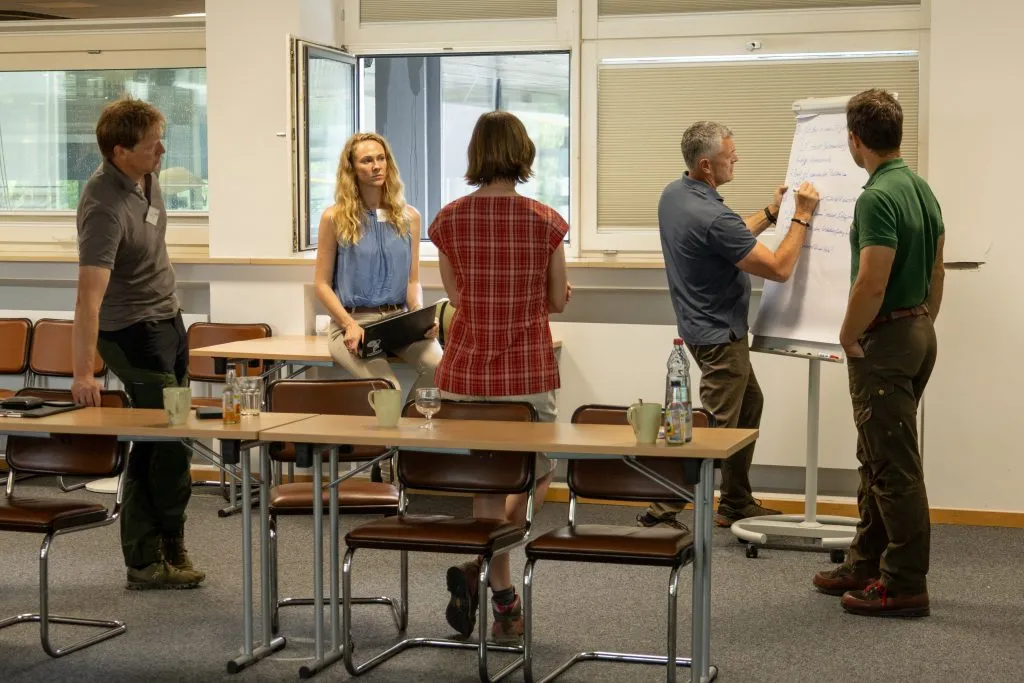
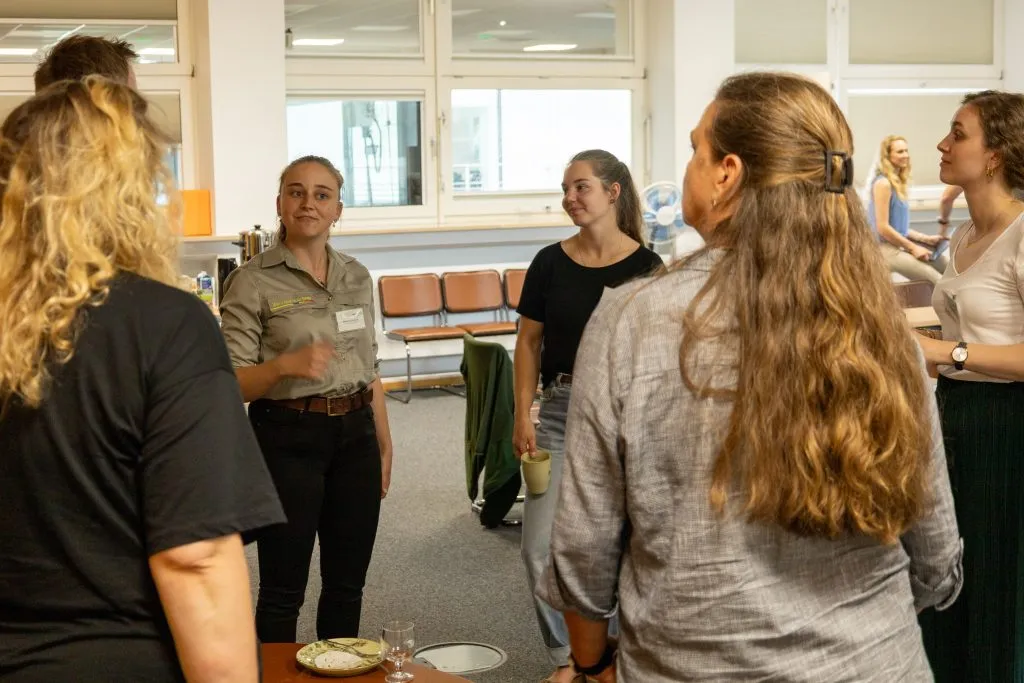
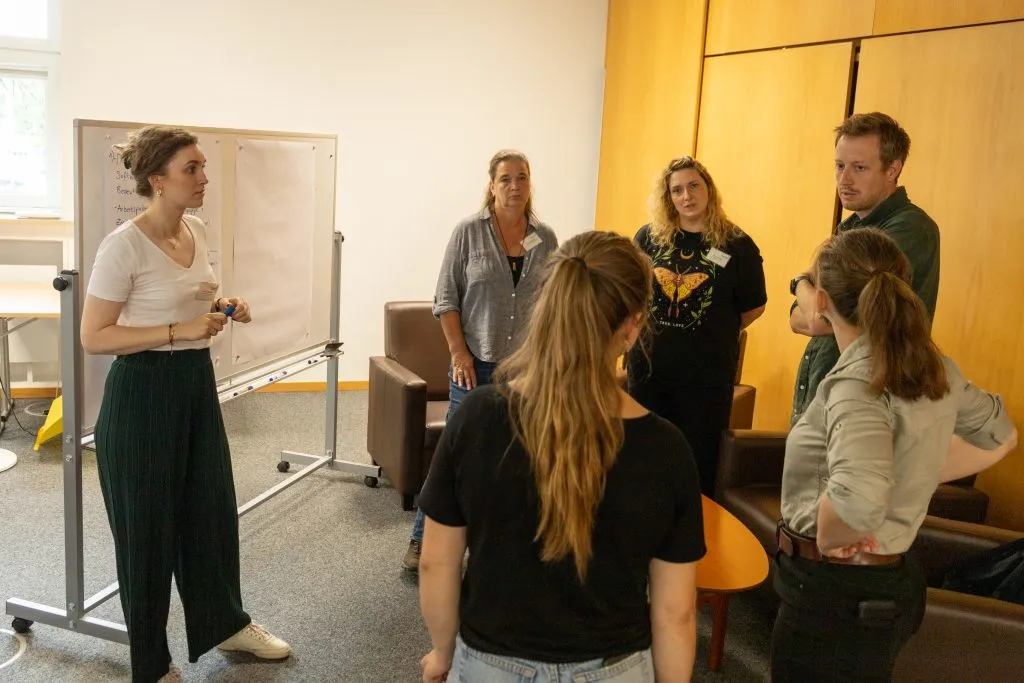
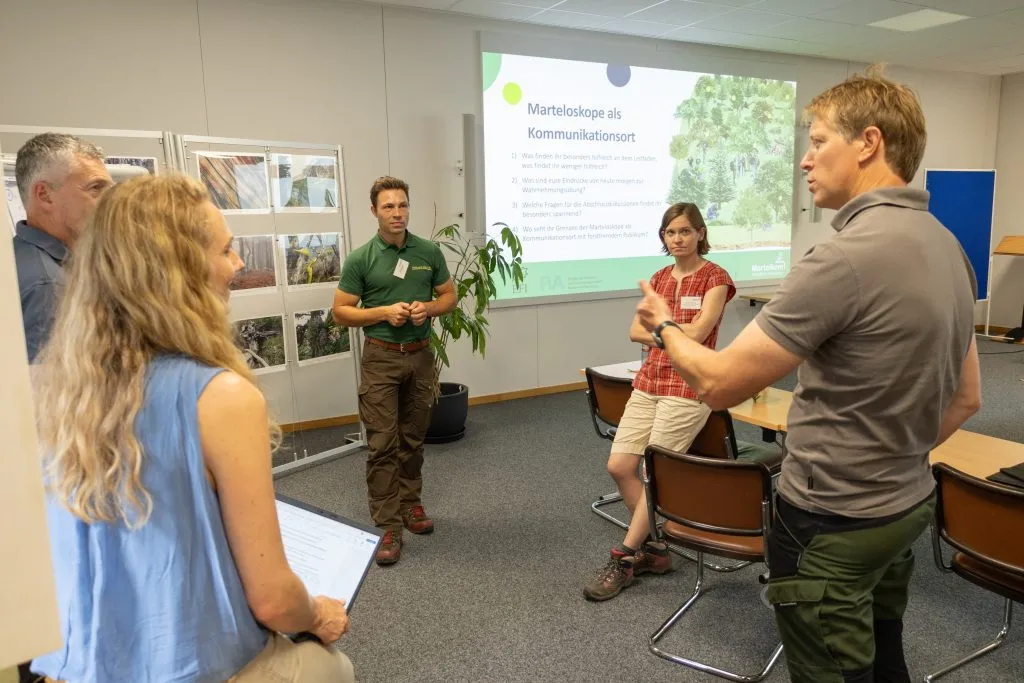
The often-defensive response of the forestry industry to expected criticism can be replaced by open, inviting communication: with examples, personal experiences, stories from the forest and life. Then it’s not just knowledge about the forest that counts but understanding the attitude with which we encounter it and ourselves.
What remains: trust, diversity, responsibility
The Martelkom final workshop wasn’t a quiet farewell – it was a motivating outlook. It showed that forest communication doesn’t need glossy brochures – it needs encounters. It begins where people walk through a forest together. Where they feel, see, smell, decide. Where they talk to each other honestly, emotionally and informatively. And above all, in a way that is understandable.
By late afternoon, the sky clears again. The sun breaks through the tree canopy. A beautiful image of what Martelkom has conveyed:
When we talk to one another – with an open mind, with respect, with a willingness to listen – the forest can become a place of connection. Between people and trees. Between use and protection. Between today and tomorrow.
Article was originally written and published by Katharina Freund in German, here. To reach a wider audience, it was translated into English by Daria Kononenko with editorial revisions by Rahel Könen.